The 50/30/20 Rule Is Outdated: Here's a Better Budgeting Framework
Why the classic 50/30/20 budgeting rule fails in 2026's economic reality, and a more flexible alternative framework that adapts to rising costs, gig income, and changing lifestyles.
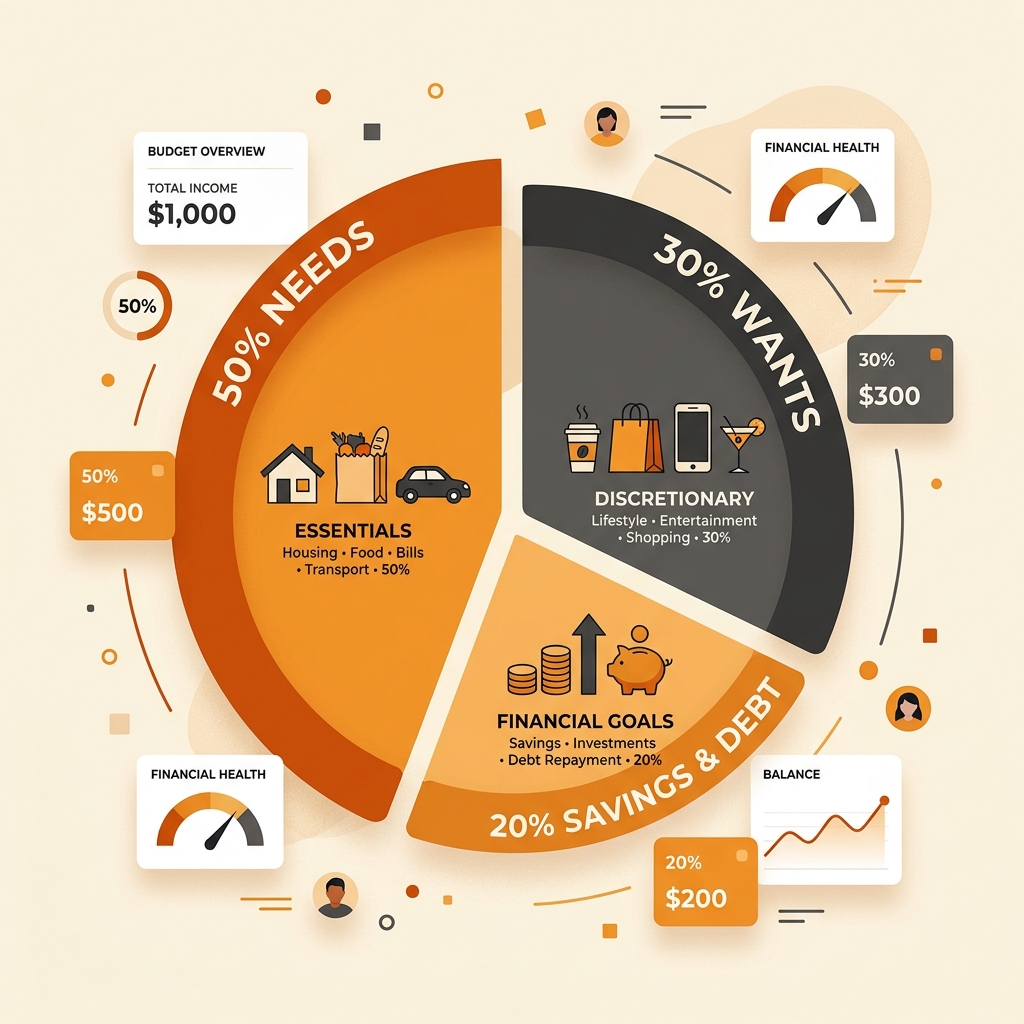
The 50/30/20 rule — spend 50% on needs, 30% on wants, 20% on savings — was popularized by Senator Elizabeth Warren in 2005. Twenty-one years later, it’s the most commonly recommended budgeting framework on the internet. It’s also increasingly disconnected from how people actually live and earn in 2026.
Why 50/30/20 Doesn’t Work Anymore
Rent Has Broken the “50% Needs” Category
In 2005, the average rent-to-income ratio in Indian metropolitan cities was roughly 20-25%. In 2026, that ratio has climbed to 35-45% in cities like Mumbai, Bangalore, and Delhi NCR for young professionals.
If rent alone consumes 40% of your income, the “50% needs” budget leaves only 10% for food, transportation, utilities, insurance, and EMIs. That’s mathematically impossible for most people.
The same problem exists globally. In major US cities, housing costs average 35-40% of take-home pay. The 50% “needs” category was designed for an era of cheaper housing, and it hasn’t been updated.
The “Wants vs Needs” Line Has Blurred
Is a ₹999/month internet connection a need or a want? In 2005, it was clearly a want. In 2026, when your job, education, banking, government services, and healthcare scheduling all happen online, it’s an essential utility.
Is a gym membership a want? Technically yes. But if your sedentary desk job is causing back problems that will eventually require expensive medical treatment, preventive fitness spending starts looking like a need.
The rigid “needs vs wants” binary creates guilt around spending that’s practically essential in modern life, and that guilt often causes people to abandon budgeting entirely.
Gig and Variable Income Breaks the Model
The 50/30/20 rule assumes a stable, predictable monthly salary. But 36% of Indian working professionals now earn at least part of their income from freelancing, gig work, or variable commissions. When your income fluctuates by 20-40% month to month, a fixed percentage allocation is unworkable.
The Adaptive Budget Framework: A Better Alternative
After researching behavioral finance and testing multiple frameworks on my own finances for a year, I’ve developed what I call the Priority Stack framework. It works like this:
Step 1: Fund Your Floors (Non-Negotiable Minimums)
Before percentage allocations, identify your absolute minimum survival costs. These are expenses that, if unpaid, create immediate serious consequences:
- Rent/EMI: Your housing payment
- Essential food: Not dining out — basic groceries for healthy meals
- Transportation to work: Not the premium Uber — the bus, metro, or bike fuel
- Minimum debt payments: EMIs, credit card minimums
- Health insurance: The premium itself, not co-pays
- Utilities: Electricity, water, basic internet/phone
Calculate this total. This is your Floor — the absolute minimum you need to function. For most young professionals in Indian metros, this ranges between 55-70% of take-home pay.
Step 2: Set Your Ceiling (Savings Target)
Now, instead of a fixed 20% savings rate, set a savings ceiling based on your current life stage:
| Life Stage | Minimum Savings Target | Why |
|---|---|---|
| First 2 years of career | 10-15% | Building skills matters more than saving; income will grow fast |
| Ages 25-30, single | 20-30% | Peak saving years — low responsibilities, growing income |
| Ages 28-35, new family | 15-20% | Expenses rise; maintaining 15% is an achievement |
| Ages 35-45, established | 25-35% | Higher income should mean higher savings rate, not just lifestyle inflation |
| Post-45 | 30-40% | Retirement acceleration phase |
The key insight: your savings rate should increase with income, not stay fixed at 20%.
Step 3: The Middle Is Flexible (Intentional Spending)
Everything between your Floor and your Savings Ceiling is your Intentional Spending Zone. This is where the framework differs most from 50/30/20 — there’s no artificial division between “needs” and “wants.” Instead, you make conscious decisions about how to allocate this space.
The rules for Intentional Spending:
- Every expense in this zone is a choice, not an obligation
- Rank your spending by joy-per-rupee: Which expenses genuinely improve your quality of life?
- Review monthly: What felt worthwhile this month? What felt wasteful?
- Allow zero-guilt spending: Once you’ve funded your Floor and Savings Ceiling, everything in this zone is permission-granted spending
Step 4: Build Adaptive Triggers
The Priority Stack adapts to income changes with simple rules:
When income increases by 10%+:
- Increase Savings Ceiling by half the raise (50% of the increase goes to savings)
- Allow the other half to expand the Intentional Spending Zone
- Do NOT increase the Floor (avoid lifestyle inflation in essentials)
When income drops by 10%+:
- Reduce Intentional Spending Zone first
- Reduce Savings Ceiling only if necessary (minimum: 10%)
- Never cut the Floor unless absolutely unavoidable
Windfall money (bonus, tax refund, freelance project):
- 50% to savings/investments
- 30% to debt payoff (if applicable)
- 20% to Intentional Spending (guilt-free)
How This Works in Practice
Let me show you a real example with a ₹60,000 monthly take-home salary in Bangalore:
Floor (Non-Negotiable): ₹38,000 (63%)
- Rent: ₹18,000
- Groceries: ₹6,000
- Transport: ₹3,000
- Utilities + Phone + Internet: ₹3,000
- Health Insurance: ₹1,500
- Minimum debt payment: ₹4,000
- Essential subscriptions (one streaming, cloud storage): ₹500
- Emergency buffer (kept liquid): ₹2,000
Savings Ceiling: ₹12,000 (20%)
- SIP in index funds: ₹8,000
- Emergency fund building: ₹4,000
Intentional Spending Zone: ₹10,000 (17%)
- Dining out / social: ₹4,000
- Gym / fitness: ₹2,000
- Entertainment / hobbies: ₹2,000
- Clothes / personal care: ₹1,000
- Buffer for unexpected wants: ₹1,000
Notice how this doesn’t force artificial categories. The person isn’t agonizing over whether the gym is a “need” or “want.” It’s in the Intentional Spending Zone — they’ve chosen it consciously, and it’s funded only after essentials and savings are secured.
The Psychology Behind the Priority Stack
The reason most budgets fail isn’t mathematical — it’s psychological. Three key behavioral insights inform this framework:
-
Loss aversion: People hate feeling restricted more than they value saving. By explicitly creating a “permission zone” for intentional spending, the framework reduces the restriction anxiety that kills most budgets.
-
Decision fatigue: The fewer decisions you make daily, the better you stick to a plan. By automating the Floor and Savings Ceiling (auto-pay rent, auto-SIP), you only actively manage the Intentional Spending Zone.
-
Progress motivation: Seeing your savings grow (even at 10-15%) is more motivating than failing at a 20% target and giving up entirely. The adaptive triggers ensure you increase your rate as income grows, rather than starting too high and burning out.
Getting Started: Your First Month
- Calculate your Floor by listing every truly non-negotiable expense
- Set your Savings Ceiling based on the life-stage table above
- The remainder is your Intentional Spending Zone
- Track Intentional Spending for one month — just observe, don’t restrict
- At month’s end, review: which spending brought genuine value? What felt wasted?
- Adjust next month’s Intentional Spending based on what you learned
The goal isn’t perfection from Day 1. It’s building awareness that compounds into better decisions over time. And unlike the 50/30/20 rule, this framework doesn’t break when your rent goes up, your income fluctuates, or your life circumstances change.
PayWise Team
Personal finance enthusiast and tech writer at PayWise. Passionate about making digital finance accessible to everyone through practical, experience-based guides.