Contactless Payments: How NFC Technology Keeps Your Money Safe
A deep dive into the security architecture of contactless NFC payments — how tokenization, encryption, and cryptographic protocols protect every tap-to-pay transaction.
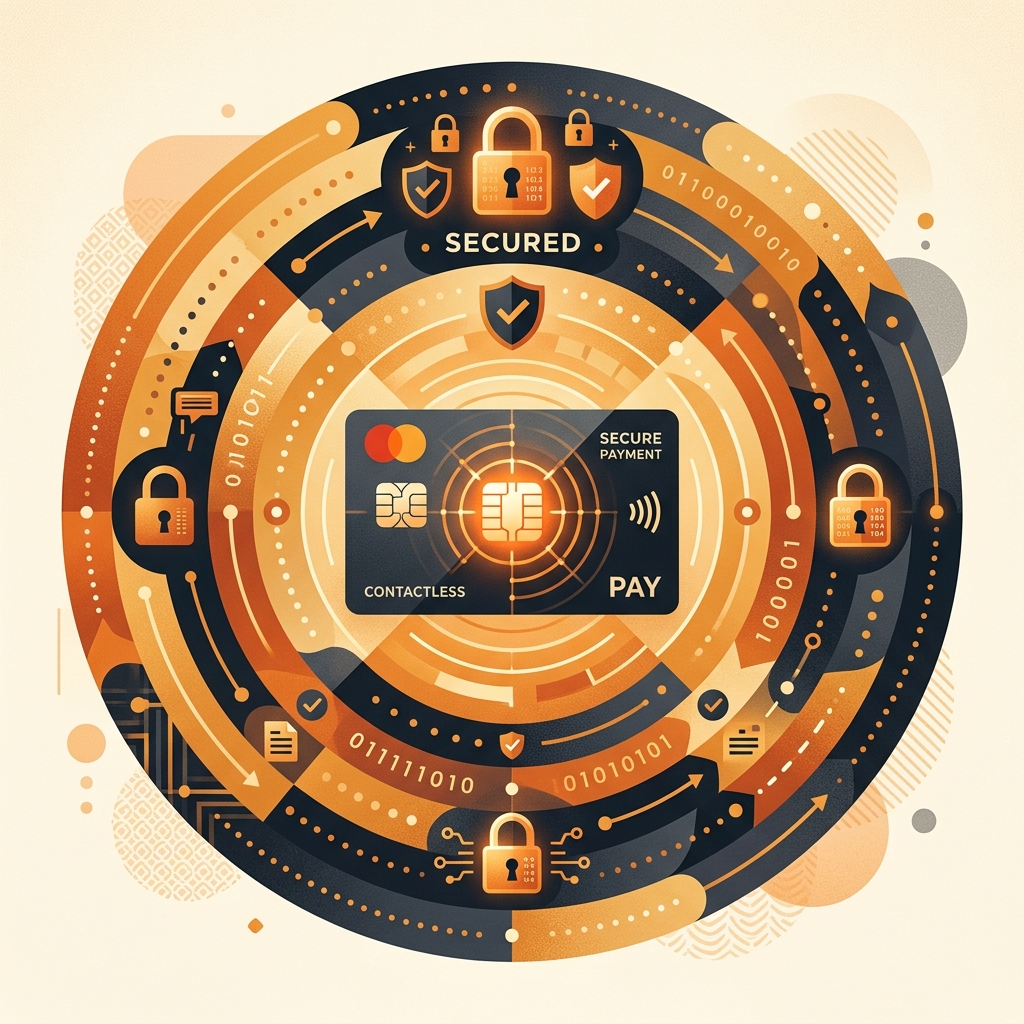
The first time a friend told me they were uncomfortable tapping their card at a terminal — worried someone might “steal” their payment data through the air — I realized how poorly understood contactless payment security actually is. The irony? Tap-to-pay is significantly more secure than inserting your card or (especially) swiping it.
How NFC Payment Security Actually Works
NFC (Near Field Communication) payments use a multi-layered security system that makes intercepting or cloning a transaction extraordinarily difficult. Let’s break down each layer.
Layer 1: The 4-Centimeter Wall
NFC operates at 13.56 MHz and has a maximum effective range of approximately 4 centimeters. In practice, most terminals require the card or phone to be within 2 centimeters. This extremely short range is the first line of defense — an attacker would need to be physically touching your card or phone to intercept data.
Compare this to Wi-Fi (50+ meters), Bluetooth (10-100 meters), or even the magnetic stripe data on a physical card (which can be captured by hidden skimmers from several centimeters away). The physics of NFC make remote interception practically impossible in real-world conditions.
Layer 2: One-Time Cryptograms
This is where contactless payments fundamentally differ from magnetic stripe transactions. When you swipe a card, the same static data is transmitted every time — your card number, expiry date, and a security code. If someone captures this data once, they can reuse it.
Contactless payments work differently. Each transaction generates a unique, one-time cryptogram — a cryptographic code that is valid for exactly one transaction. Even if an attacker somehow captured the data transmitted during your tap, the cryptogram has already been “used” and cannot be replayed for another transaction.
The cryptogram generation works like this:
- The terminal sends a challenge (a random number) to your card or phone
- Your card combines this challenge with the transaction amount, a counter, and a secret key stored in the secure element
- An algorithm (typically 3DES or AES-256) processes these inputs to produce a unique code
- This code is sent back to the terminal and verified by the card network
The secret key never leaves the card. The same inputs will never produce the same cryptogram because the counter increments with every transaction. It’s mathematically elegant security.
Layer 3: Tokenization (For Phone Payments)
When you pay with your phone (Google Pay, Apple Pay), an additional security layer kicks in: tokenization. Your real card number is never transmitted or stored on the device. Instead, a device-specific token acts as a proxy.
If a criminal somehow cloned your phone’s token, it would be useless because:
- The token is bound to your specific device’s secure element
- It requires your biometric (fingerprint/face) to activate
- Each transaction still generates a unique cryptogram on top of the token
This is triple-layered security: you need the physical device, the biometric match, and the one-time cryptogram — all within 4 centimeters of a legitimate payment terminal.
Layer 4: Transaction Limits and Velocity Checks
Most contactless systems have built-in guardrails:
- Per-transaction limits: In India, contactless transactions up to ₹5,000 don’t require a PIN. Above that threshold, PIN entry is mandatory regardless of NFC capability.
- Velocity checks: If your card detects an unusual number of contactless transactions in a short period, it will decline and require chip + PIN verification.
- Cumulative limits: Some banks set daily contactless spending caps (e.g., ₹15,000) after which all transactions require PIN authentication.
What About “Wireless Card Skimming”?
You may have seen alarming news stories about criminals walking through crowds with portable NFC readers, stealing card data from people’s pockets. Let’s examine whether this threat is real.
In theory: Yes, someone could build a portable NFC reader, hold it against your wallet, and attempt to read your contactless card’s data.
In practice: Even if successful, the attacker would only get:
- A tokenized or masked card number
- An expired one-time cryptogram
- No CVV (not transmitted in NFC transactions)
- No PIN
This data is essentially useless for making purchases. They can’t use it online (no CVV), can’t clone a chip card (dynamic authentication), and can’t replay the transaction (one-time cryptogram). The attack costs more to execute than the potential gain.
This is why there are virtually zero confirmed cases of NFC “walk-by” fraud resulting in actual financial loss, despite the technology being widespread for over a decade.
Comparing Security Across Payment Methods
| Security Feature | Magnetic Swipe | Chip + PIN | Contactless NFC | Phone NFC (Tokenized) |
|---|---|---|---|---|
| Static vs. Dynamic data | Static | Dynamic | Dynamic | Dynamic |
| Card number transmitted | Full number | Full number | Masked/tokenized | Token only |
| One-time cryptogram | No | Yes | Yes | Yes |
| Biometric auth | No | No | No (under limit) | Yes |
| Skimmable | Easily | Very difficult | Extremely difficult | Not possible |
| Replay attacks | Possible | Not possible | Not possible | Not possible |
Practical Security Tips
Even though NFC is inherently secure, here are practical steps to maximize your safety:
- Enable transaction notifications: Instant SMS/push alerts for every transaction let you spot unauthorized activity within seconds
- Use your phone instead of card when possible: Phone payments add tokenization and biometric layers on top of NFC security
- Don’t disable contactless unless you have a specific concern: Card fraud rates are actually lower for contactless than chip + PIN transactions
- Set sensible transaction limits: Use your banking app to set daily contactless limits that match your spending patterns
- Keep your phone’s OS updated: Security patches for the secure element and payment frameworks are included in OS updates
The Numbers Don’t Lie
According to the RBI’s annual payment fraud report, contactless card fraud accounts for less than 0.01% of total card fraud — making it the safest card-based payment method available. For comparison, online card-not-present fraud (entering card details on websites) accounts for over 73% of card fraud.
The technology was designed with security as a first principle, not an afterthought. Every layer — from the 4cm range to one-time cryptograms to biometric gatekeeping — exists specifically to make the convenience of tap-to-pay equally matched by its security.
The next time someone tells you contactless payments are risky, you can explain why the opposite is true.
PayWise Team
Personal finance enthusiast and tech writer at PayWise. Passionate about making digital finance accessible to everyone through practical, experience-based guides.