How Inflation Quietly Eats Your Savings and What to Do About It
An accessible explanation of how inflation erodes purchasing power over time, why your savings account is losing money in real terms, and practical strategies to inflation-proof your finances.
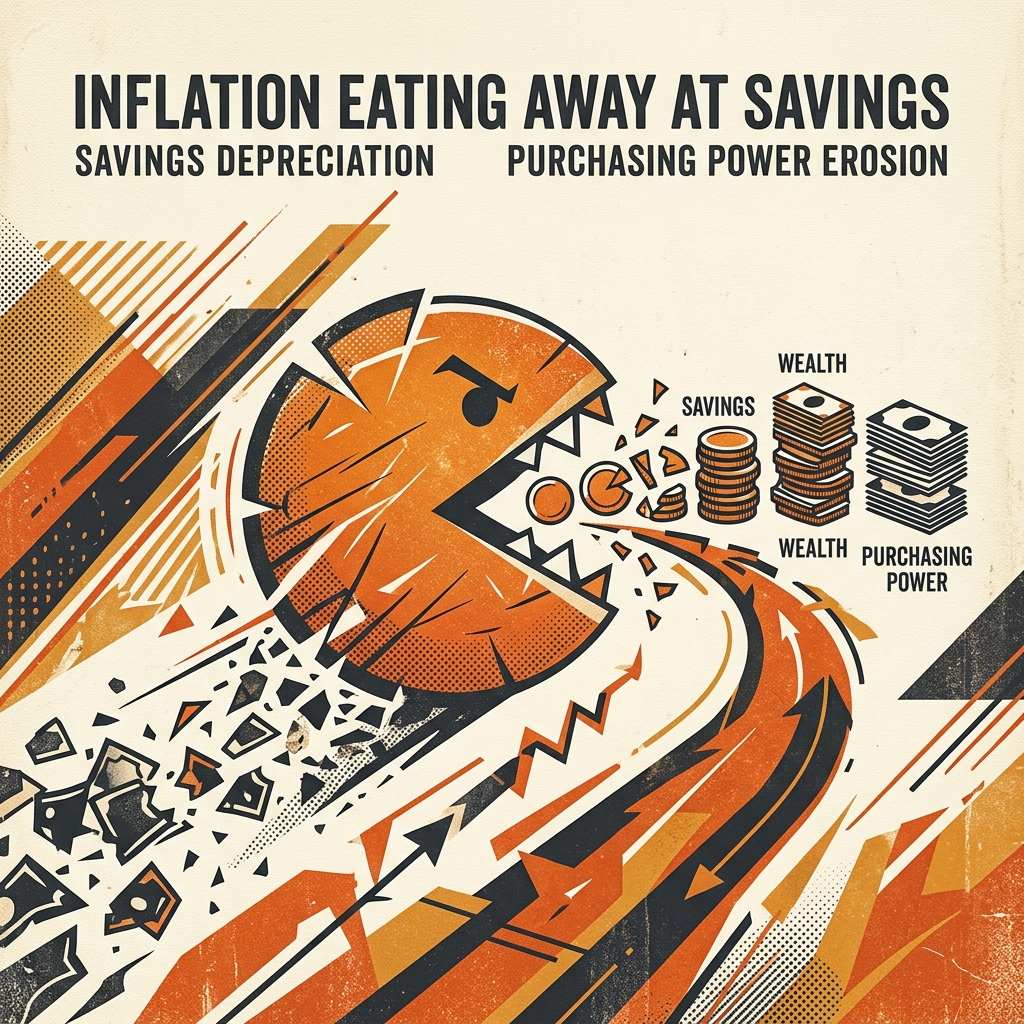
Your savings account is losing money. Not in the way your bank statement shows — the number keeps growing. But in purchasing power, the actual goods and services your money can buy, you’re getting poorer every year you keep significant cash in a savings account. Here’s the math that banks don’t want you to think about.
The Invisible Tax
In 2016, a plate of chole bhature in Delhi cost about ₹60. In 2026, the same plate at the same stall costs ₹120. That’s 100% food inflation over 10 years, or roughly 7.2% per year.
During that same period, a savings account paid about 3.5-4% interest annually. Let’s calculate what happened to ₹10,000 left in savings for those 10 years:
Nominal value (what the bank shows): ₹10,000 × (1.04)^10 = ₹14,802
Real value (what it can actually buy): ₹14,802 ÷ (1.072)^10 = ₹7,389 in 2016 purchasing power
Your savings account turned ₹10,000 into ₹14,802 on paper — a 48% gain. But in terms of what you can actually purchase, that ₹14,802 buys less than the ₹10,000 could buy 10 years ago. You gained numbers; you lost purchasing power.
This is the inflation tax — invisible, automatic, and devastating over long periods.
Where Inflation Hits Hardest
Not all prices rise equally. India’s headline CPI inflation averages 5-6%, but specific categories inflate much faster:
| Category | Approximate Annual Inflation | Impact |
|---|---|---|
| Education | 10-12% | School fees double every 6-7 years |
| Healthcare | 8-10% | Medical costs double every 7-9 years |
| Housing (metro rents) | 7-9% | Rental costs double every 8-10 years |
| Food | 6-8% | Grocery costs double every 9-12 years |
| Electronics | -3 to -5% | Tech gets cheaper (rare deflation!) |
| Clothing | 3-5% | Slow inflation due to mass production |
The categories that inflate fastest — education, healthcare, housing — are also the ones you can’t easily cut. This means that for families planning for children’s education or aging parents’ healthcare, the effective inflation rate is much higher than the headline 5-6%.
Why Your Savings Account Is the Wrong Place
Here’s the core problem in one table:
| Investment | Average Annual Return | Inflation (average) | Real Return |
|---|---|---|---|
| Savings Account | 3.5-4% | 5-6% | -1.5 to -2% |
| Fixed Deposit (1 year) | 6.5-7.5% | 5-6% | +0.5 to 2% |
| Debt Mutual Fund | 7-8% | 5-6% | +1 to 3% |
| PPF | 7.1% | 5-6% | +1 to 2% (tax-free) |
| Equity Index Fund (long term) | 12-14% | 5-6% | +6 to 9% |
A savings account has a negative real return. Every year your money sits in savings, it buys less. This isn’t a crisis for your emergency fund (which needs to be liquid), but it’s a catastrophe for long-term savings like retirement.
The Inflation-Proofing Strategy
For Money You Need Within 1 Year: Accept the Inflation Loss
Your emergency fund and short-term spending money should stay in a savings account or liquid fund. Yes, you’re losing 1-2% to inflation. That’s the cost of liquidity and safety. Accept it as the price of financial security.
For Money You Need in 1-3 Years: Beat Inflation Slightly
Park this in:
- Short-term debt mutual funds (7-8% returns, moderate safety)
- Fixed deposits (6.5-7.5%, guaranteed)
- Post office schemes (7-8%, government-backed)
You won’t get rich, but you’ll approximately keep pace with inflation while keeping risk low.
For Money You Need in 3-7 Years: Grow Above Inflation
Use a balanced approach:
- 60% in hybrid mutual funds (mix of equity and debt)
- 40% in debt instruments (FDs, debt funds, PPF)
This blend targets 9-10% returns — comfortably above inflation — with manageable volatility.
For Money You Need After 7+ Years: Seriously Outpace Inflation
This is retirement money, children’s education fund, or wealth building:
- 80% in equity index funds (Nifty 50, Nifty Next 50)
- 20% in PPF or debt (stability anchor)
Equity returns of 12-14% over 10+ year periods have consistently beaten inflation by 6-9% — turning ₹10,000 per month SIP into ₹23-28 lakh after 10 years (vs ₹15 lakh if kept in savings).
The SIP Solution
Systematic Investment Plans (SIPs) are the most practical inflation-fighting tool available:
- Start small: Even ₹500/month in a Nifty 50 index fund
- Increase annually: Add 10% to your SIP each year (called a “step-up SIP”)
- Don’t time the market: Monthly SIP automatically averages your purchase price across market highs and lows
- Stay invested through downturns: Market drops are when SIP buying power is highest — you’re buying more units at lower prices
The power of step-up SIPs: A ₹5,000/month SIP with a 10% annual increase, over 20 years at 12% returns, grows to approximately ₹95 lakh. The same ₹5,000 without step-ups grows to about ₹50 lakh. The step-up nearly doubles your wealth.
Three Actions to Take Today
-
Calculate your inflation exposure: How much of your total savings is in instruments that return less than 6%? That’s your inflation-exposed amount.
-
Start one equity SIP: Even ₹500/month. The amount matters less than starting the habit and getting exposure to inflation-beating returns.
-
Separate your savings by time horizon: Money for this year stays in savings. Money for 3+ years moves to investments. Money for 7+ years goes to equity. This single reorganization can add lakhs to your lifetime wealth.
Inflation is the one financial risk you can’t avoid. But you can ensure that your money grows faster than prices rise. And the earlier you start, the more powerfully compounding works in your favor.
PayWise Team
Personal finance enthusiast and tech writer at PayWise. Passionate about making digital finance accessible to everyone through practical, experience-based guides.